Introduction: is ElevenLabs worth trying?
An AI voice tool can turn a finished script into narration without arranging a recording session for every edit. The harder question is whether the voice suits your audience, handles your terminology, and saves time after review. ElevenLabs deserves a place on a shortlist for that evaluation because it combines speech generation, voice creation, and localization workflows.
Our quick verdict: consider ElevenLabs for recurring video narration, learning content, or multilingual audio projects. If you only need an occasional rough voiceover, test the free option before buying a broader plan. If performance direction or a distinctive human delivery is central to the work, compare an AI workflow with a professional recording rather than assuming automation is the better choice.
This is a documentation-based review, checked against official ElevenLabs pages on October 11, 2026. We captured the public website but did not run a controlled listening test, benchmark competing tools, or test paid workflows. Recommendations below are editorial judgments about fit; provider demonstrations and claims are not independent proof of performance.
What is ElevenLabs?
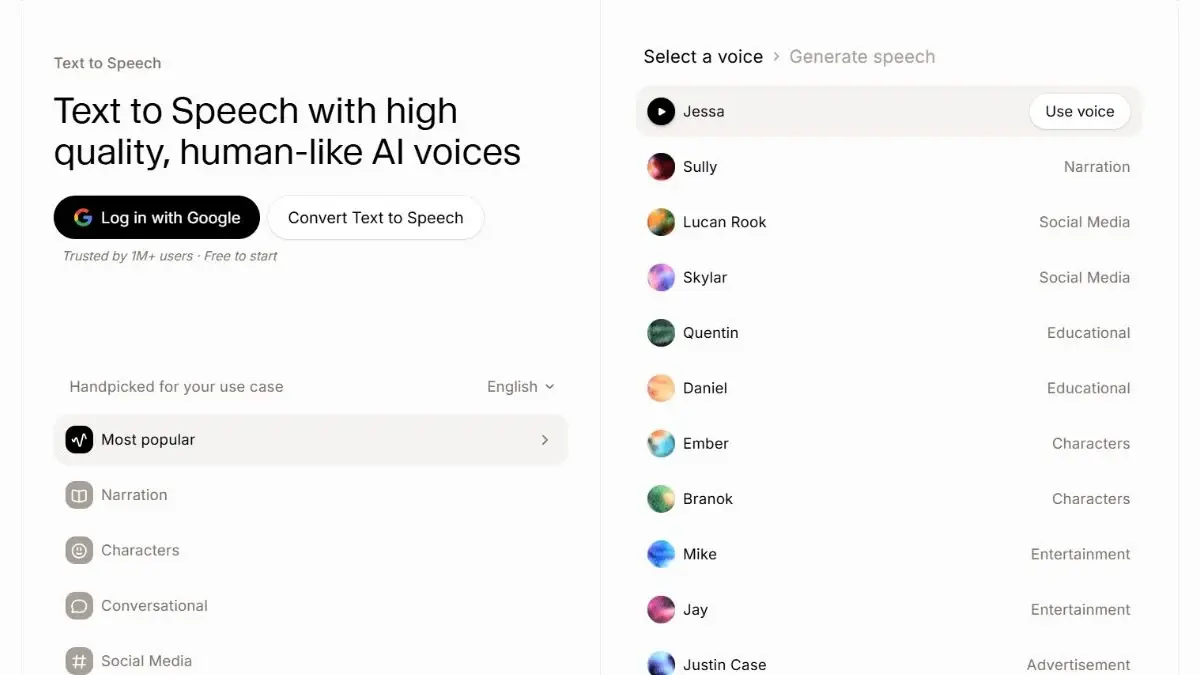
ElevenLabs is a platform for generating and working with AI audio. For this review, the relevant parts are text to speech, voice cloning, Studio, and dubbing. The company also offers developer APIs and a separate voice-agent platform. Those broader products should not be treated as identical to a creator subscription.
Text to speech starts with a written script and produces spoken audio using a selected voice and model. Voice cloning creates a voice from recordings, while dubbing translates existing spoken content for another audience. These solve different problems: drafting narration is not the same workflow as localizing a video that already contains several speakers.
Choose around the asset you need to deliver. A training team may care about consistent narration and manageable revisions; a video publisher may care about dialogue and localization; a developer may need API controls and integration testing. The same feature list can lead to very different purchasing decisions.
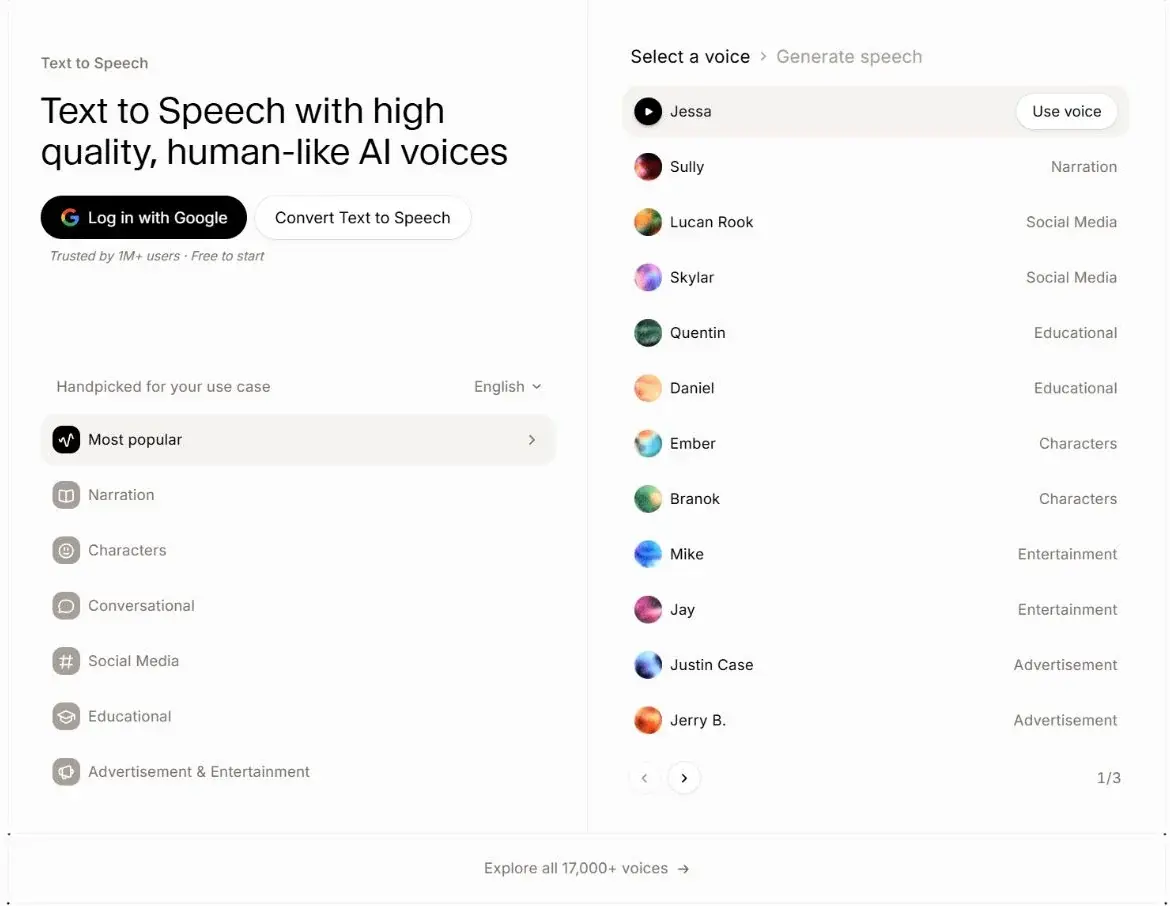
Official sources: Text to speech overview · Studio overview
Standout feature: text to speech and model choice
ElevenLabs offers several speech models rather than one uniform voice engine. Current documentation lists the Eleven v4 family for expressive speech and dialogue, Multilingual v2 for long-form generation, and Flash/Turbo models for workflows where response time matters. Availability and behavior depend on the selected model and interface.
Language coverage is model-specific. The official model documentation lists 90+ languages for the v4 family, 29 for Multilingual v2, and 32 for Flash/Turbo v2.5. Do not apply the largest number to every voice or endpoint. Check your target language and regional pronunciation against the model you will actually use.
For narration, start with a small selection of voices and the same short script. For an interactive application, evaluate the intended API path as well as audio output. Provider latency figures describe particular technical conditions; they do not establish the response time of your finished application.
Official sources: Model capabilities and supported languages
Voice cloning: instant and professional options
Instant Voice Cloning and Professional Voice Cloning are separate features. The pricing page includes Instant Voice Cloning from Starter and Professional Voice Cloning from Creator. Treat these as different setup commitments, not interchangeable names for an unlimited cloning allowance.
The professional workflow requires recordings and voice verification. ElevenLabs says Professional Voice Cloning can only be used for your own voice, even if another person has given consent. Someone else who wants a professional clone must create and verify their own voice and use the supported sharing workflow.
Before choosing cloning, decide whether a library voice would do the job. A clone is useful when continuity of a particular voice is important, but it adds decisions about recording quality, access, permission, and future use. Keep voice recordings out of a casual pilot unless you understand and accept the provider’s policies.
Official sources: Voice cloning overview · Professional cloning setup · Whose voice can be professionally cloned?
Dubbing: localizing existing audio and video
Dubbing is relevant when your source material already contains spoken performances. ElevenLabs describes Dubbing v2 as a source-performance-based model covering 90+ languages and accents, with translation and voice cloning in the workflow. It is designed to carry aspects of the original delivery into the translated result; that is a provider description, not a guarantee of flawless localization.
A useful pilot is one short video with representative vocabulary and more than one speaker. Have a fluent reviewer check the translation, names, meaning, speaker identity, and timing. Review the complete video rather than judging isolated sentences: a line can sound plausible while changing the meaning of the scene.
Dubbing costs should be estimated separately from text-to-speech narration. Official help documentation bills it per minute of source media for each target language, with rates varying by model. Adding languages increases the work and cost; inspect the quoted charge before starting. Do not multiply a generic subscription-minute estimate and assume it covers every dubbing mode.
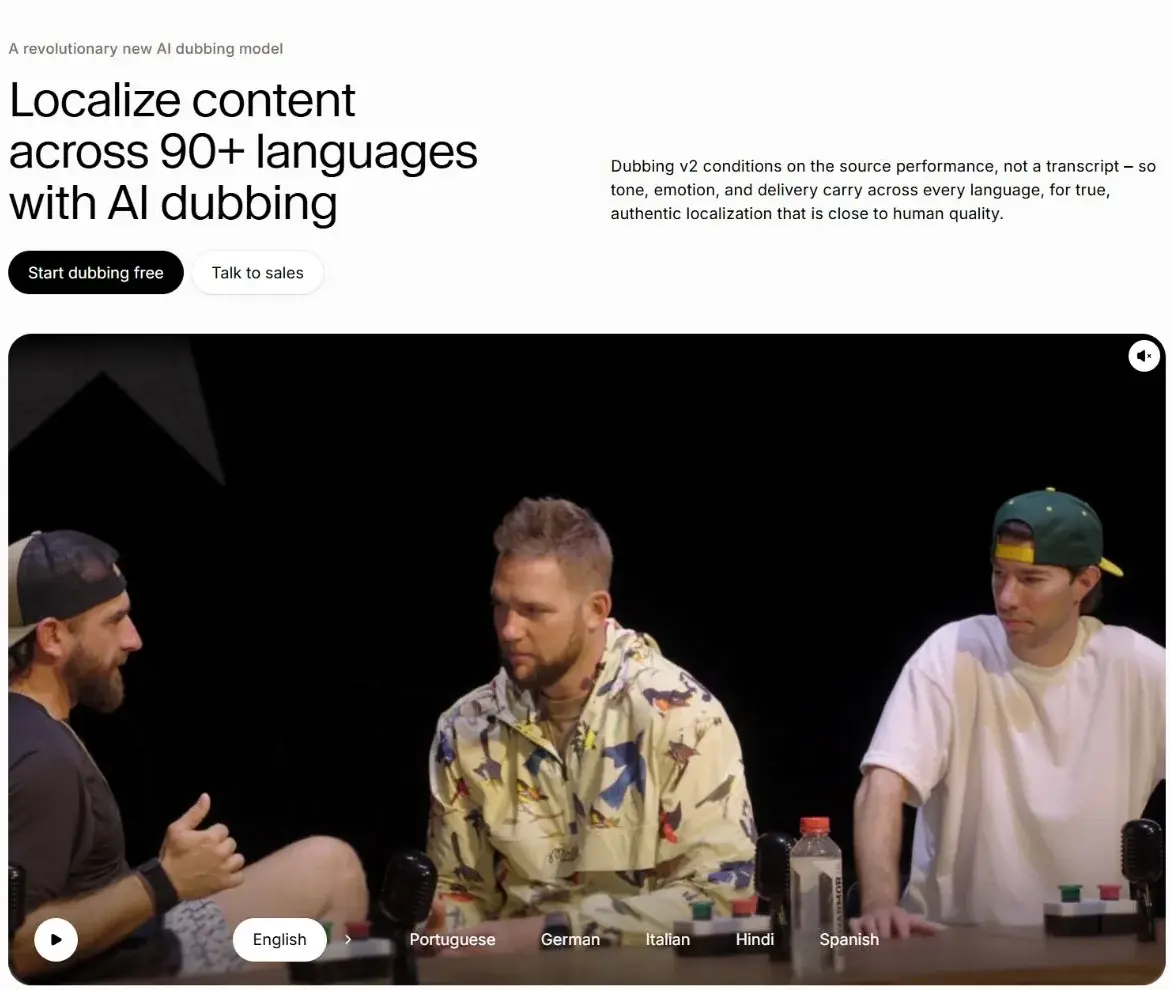
Official sources: Dubbing product page · How dubbing is billed
Studio: assembling a finished production
Studio provides an editing workspace for audio and video projects, including narration and longer content. It is worth evaluating when your task extends beyond downloading a single generated clip. A project workflow can help you organize text, voices, and production assets in one place.
Test the entire handoff: import a script, generate a section, correct one sentence, and export the format your next editor needs. Check whether a small correction forces unnecessary rework and whether project limits fit your output volume. The most useful workspace is the one that makes revisions predictable for your team.
Avoid treating a broad creative suite as a replacement for every production role. Script approval, pronunciation checks, sound editing, and final review still need an owner. Those steps should be part of the time and cost comparison.
Official sources: Studio product and workflow overview
Voice quality: what to listen for before buying
ElevenLabs markets its voices as expressive and human-like. We cannot turn that description into a measured quality score without testing. The appropriate question is whether a particular voice and model produce acceptable audio for your own material, not whether an impressive sample sounds natural once.
Use a test script containing a normal introduction, a dense sentence, a name, numbers, an acronym, and a phrase that needs emphasis. Listen at the playback speed and on the device your audience will use. Record pronunciation errors, awkward pauses, inconsistent emotion, and the effort needed to fix them.
For longer narration, check continuity between sections and whether the delivery becomes tiring. For another language, involve a fluent reviewer rather than relying on your impression of the voice. A smooth delivery can mask a translation or pronunciation problem.
Compare tools with the same script and a defined acceptance standard. Count review time and regenerations alongside generation time. This gives you a more defensible buying decision than an unsupported star rating or a claim that one tool always sounds better.
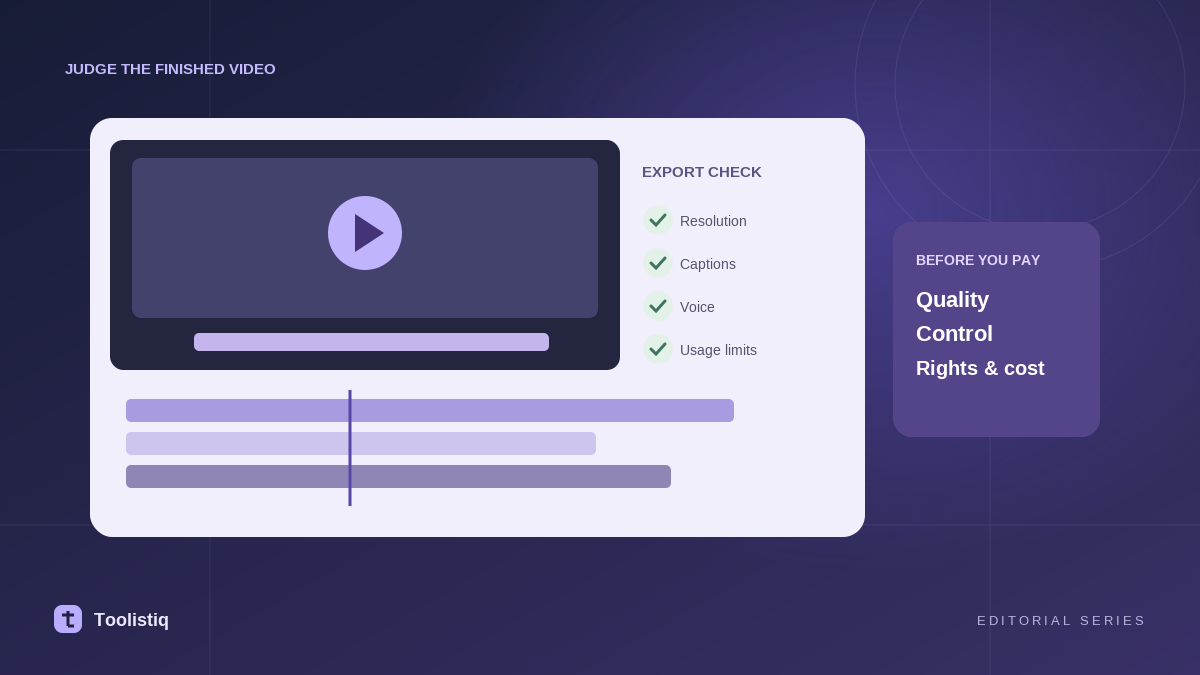
Use representative material
Include your terminology, names, numbers, and a difficult sentence.
Review the finished output
Check intelligibility, pacing, consistency, and meaning in context.
Measure correction effort
Record revisions and reviewer time before judging value.
Pricing overview: subscriptions, credits, and real cost
The ElevenCreative monthly pricing page lists Free at $0 with 10,000 credits; Starter at $6 with 30,000; Creator at $22 with 121,000; Pro at $99 with 600,000; Scale at $299 with 1.8 million; and Business at $990 with 6 million. Enterprise has custom pricing. These are standard monthly USD prices checked October 11, 2026, excluding taxes, not annual equivalents or introductory offers.
Starter includes a commercial license and Instant Voice Cloning; Creator adds Professional Voice Cloning. Higher plans expand production allowances and team capabilities. Agent and API pricing have separate pages. Verify the product and billing period before choosing a tier.
Credits are shared across products, and consumption depends on the feature and model. Do not treat credits as a universal number of finished minutes. Budget for normal revisions and other audio tasks drawing from the same allowance. The screenshot includes temporary first-month promotions; those are not the ongoing prices above.
A practical estimate is subscription cost plus any additional usage plus review time. Test a representative project before annual commitment. Check the live pricing calculator and current terms for your intended workflow.
| Plan | Standard Monthly USD Price | Monthly Credits |
|---|---|---|
| Free | $0 | 10,000 |
| Starter | $6 | 30,000 |
| Creator | $22 | 121,000 |
| Pro | $99 | 600,000 |
| Scale | $299 | 1,800,000 |
| Business | $990 | 6,000,000 |
| Enterprise | Custom pricing | Custom allowance |
Standard monthly USD prices checked October 11, 2026, excluding taxes. These are not annual-billing equivalents or temporary first-month promotions. Confirm current pricing and allowances with ElevenLabs before purchase.
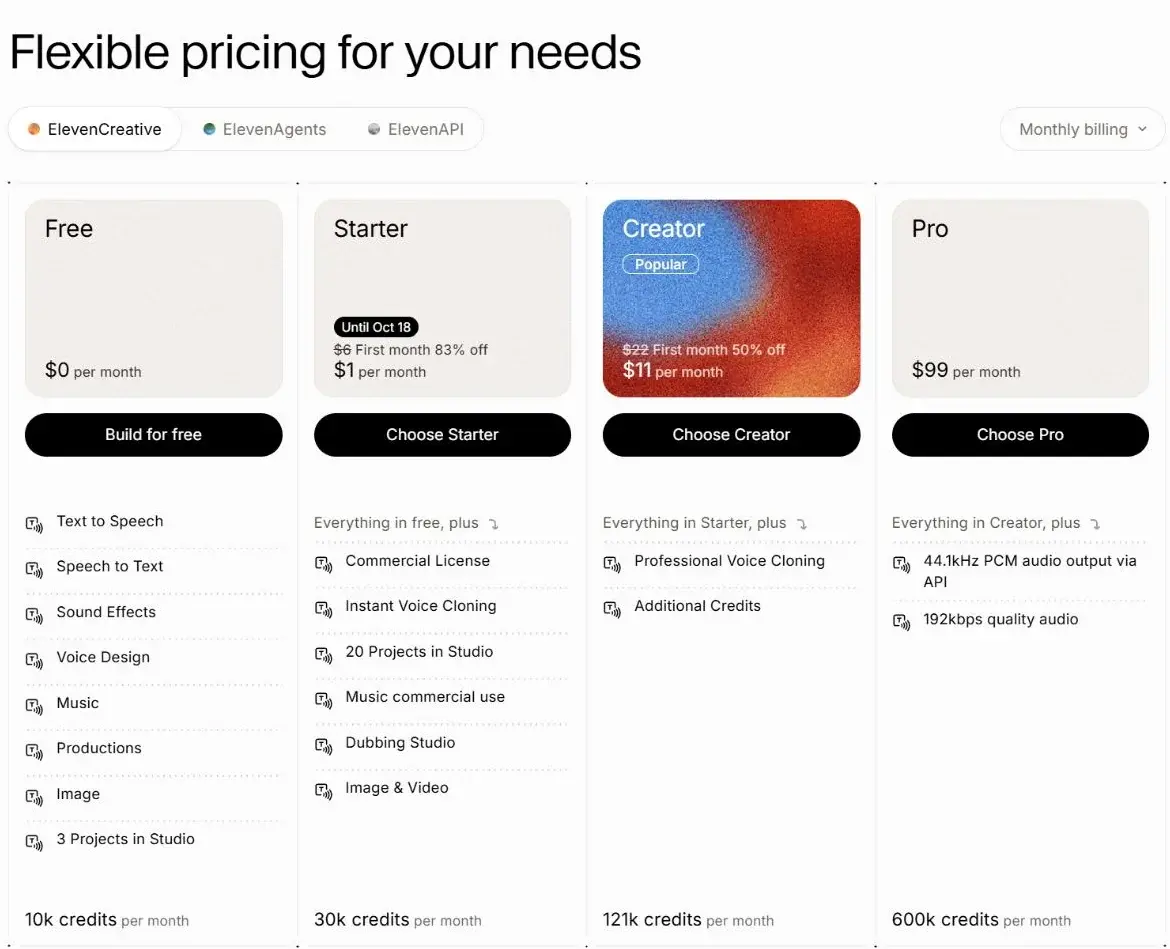
Official sources: Current plans and pricing · Billing and credits
Free access and commercial rights
The free plan can support an initial evaluation, but it is not a commercial production license. ElevenLabs’ billing documentation describes free-plan output as non-commercial with attribution, and paid-plan output as carrying commercial rights subject to its terms. A paid subscription does not remove obligations around the script, voice, or other source material.
For client work, advertising, or monetized content, verify the applicable license before generating production audio. Keep approved scripts and relevant permissions with the project. Do not assume upgrading later automatically changes the rights attached to previously generated free-plan output; check the provider’s current terms for that situation.
Official sources: Provider billing and commercial-use guidance
Best use cases: where a pilot is worthwhile
Video narration and learning content are sensible starting points when scripts are approved and updated repeatedly. Choose a voice that fits the audience, then evaluate how easily your team can replace a corrected section without disrupting the rest of the production.
Audiobooks and longer educational material deserve a more demanding test. Listen across chapters, verify difficult vocabulary, and establish consistent editorial direction. Longer output increases the importance of review and a reliable editing workflow.
Multilingual localization can be useful when you already have source media and qualified reviewers. Plan a language-specific review budget instead of treating the translation step as the end of the project.
Developers building spoken interfaces can evaluate the APIs, but integration, response times, consent, and application behavior need separate testing. This creator-focused review does not establish suitability for a regulated or safety-critical deployment.
Pros and cons: strengths and practical tradeoffs
The main editorial strength is the range of connected voice workflows: you can evaluate narration, a consistent custom voice, and localization within the same platform. Different models and interfaces provide options for distinct production needs rather than forcing one approach onto every task.
The main tradeoff is evaluation complexity. Models, product pricing, credit consumption, licensing, and plan-specific features all matter. Access to more capabilities does not automatically produce a better finished asset, and neither translation nor speech generation removes the need for review.
Reasons to shortlist
Several voice workflows, model choices, and a free starting point for a non-commercial evaluation.
Reasons to pause
Shared usage budgets, paid cloning requirements, and human review of pronunciation, translation, and rights.
Who is ElevenLabs best for?
Our strongest recommendation is to trial it for creators and small production teams with recurring narration or localization tasks, a clear script approval process, and someone responsible for audio review. A repeatable workflow makes it easier to judge whether the subscription saves meaningful effort.
It is less compelling if you rarely need audio, cannot budget for correction, or need a human performance that you can direct live. Teams primarily editing recorded interviews may value editing workflow more than voice generation; compare tools using the task you perform most often.
Final verdict: shortlist it, then test the finished result
ElevenLabs is worth a structured trial if narration, a consistent voice, or dubbing is central to your output. Start with the smallest plan that lets you evaluate the relevant workflow under the correct license. Move up for a specific requirement, such as professional cloning or team access, rather than a vague expectation of better results.
Before committing, complete one representative project and record quality problems, revision time, usage, and export fit. Choose it when the approved audio meets your standard at a sustainable total cost. There is no universal winner for every language, genre, or production team.
ElevenLabs
- Best for
- Recurring narration and localization with an established review workflow
- Pricing
- ElevenCreative: free non-commercial evaluation; standard Starter $6/month as checked October 11, 2026. Verify current provider terms.
Key strengths
- Text to speech, cloning, and dubbing workflows in one platform
- Model options for different voice-production needs
What to consider
- Credits and feature access vary by product, model, and plan
- Pronunciation, translation, and permissions still require review
Explore ElevenLabs (opens in a new tab)
View Details for ElevenLabs →